


Why particles might need spin
- Warren Frisina

- Jun 16, 2020
- 3 min read
We know particles have spin because of the literature and something happens in experiments to particles subject to magnetic fields that is explained abstractly in quantum theory. But we are talking about something that actually spins like a top or a whirlwind. Why would such a proposed particle need spin -- actually rotate? It might start with Mach again, whose Principle was an early inspiration to Einstein for general relativity. Recall, Mach saw himself in a stationary reference frame, and imagined the universe spinning around him, rather than spinning himself and watching his arms move outward due to "centrifugal force." He thought there must be some connection between himself and the universe at large.
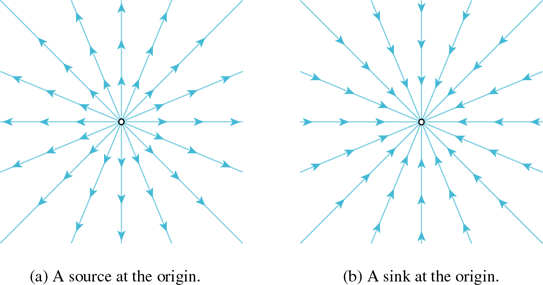
It has been suggested in previous posts at this site that there might indeed be such a connection. If gravity is fundamentally repulsive and seated in the large-scale cosmic voids possibly housing dark energy (surrounded by galactic supercluster shells), the gravitational/(dark energy) field would point from the center of the essentially spherical voids to the visible matter shells. This is an active field, causing the void and surrounding supercluster shell to expand under acceleration. Each field line, so to speak, is pointing to and contacting corresponding particle of matter in the visible matter shell.
Now, if this connecting gravitational field line is thought to be a fine silk spider thread -- one for each subatomic particle in Mach's body -- when he spins around, all those individual threads might tend to twist him like someone twisting a wet rag to get the water out. Both Mach and each particle within might feel the effect. The incoming field might tend to concentrate; the faster he spins the greater the effect. In this way mass might be non-local. Each particle making up Mach would have to be spinning at high rates to achieve the strong force, for instance, that comprise his quarks and holds his protons and nucleons together. It is at least conceivable, then, for the strong force to be derived from weak gravity.
Consider, Fg,n = [(n/2)^1/2 (alpha-g)^-1/2 + (n/2)^3/2 (alpha-g)^-3/2] Gc^2m^4 / 4h^2 (1)
where m = quark mass = [(H/G)(h/c)^2]^1/3, H in acceleration units. (2)
and where n=1, and (alpha-g) is the gravitational coupling constant. (3)
This expression represents the predicted force containing quark integrity and the strong force. It was derived with special relativity and Newtonian gravity implied. In the relativity portion the velocity of the spinning field was made to approach light speed. The combined Equation (1,2,3) was theoretically confirmed by it's use in an expression that derived the unit (electron) charge.
Considering special relativity in the conventional manner, where a particle is made to approach light speed in a linear accelerator, for instance, the mass of the particle is commonly said to increase. This mass increase should increase the gravitational field of the particle. Thus the spinning and linear motions might yield similar effects in that a spinning entity has part of itself moving at a tangential velocity near light speed.
Now to compare the proposed non-local source of mass, and the local source:
non-local mass and strong force (seated in cosmic voids but pointing at and contacting particle): spinning directly might cause higher field by concentrating weak field lines. Common low intensity gravitational field the sole participant; proposed.
local mass (seated in particle): said to derive from the Higgs field; conventional quantum theory and experiment; gravity not included.
To answer the original question, at least in part, non-local particles might need spin to activate special relativistic effects in the proposed in order to boost the marginal effects of a repulsive form Newtonian gravity. This repulsive form of Newtonian gravity has been discussed in previous posts at this site.


Comments