


UNIVERSAL DYNAMICS: Is gravity essentially repulsive?
- Warren Frisina

- Jun 16, 2020
- 3 min read
Newtons three laws of motion and of "universal gravitation" have dragged us out of squalor and scientific ignorance. But it seems that we are slipping back somewhat. The astronomers and astrophysicists of today have again displayed our ignorance of the heavens. When we tried to apply classical Newtonian gravitation to a galaxy, for instance, about half the galaxy was missing.
However, it was not assumed that classical Newtonian gravity was incorrectly applied. It was assumed the equation was completely wrong in this situation, and an entire industry was created to make something like the original equation fit the new situation. The industry is called Modified Newtonian Dynamics (MOND). However, this line of thought leads to a different equation for each astronomical body, i.e. clusters of galaxies, or globular stellar clusters, or the behavior of galactic superclusters (having a repulsive character). This is far from the original ideal of "universal gravitation."
However, interesting new elements have arisen; also, the "fault" of the astronomers. They have noticed that the universe is not only expanding, but also accelerating. The theorists of general relativity have labeled this acceleration the cosmological constant, and those of quantum theory, the quantum vacuum energy. There is general agreement, then, that something is causing the acceleration, and that the something has a repulsive character.
The large-scale structure of the universe appears as a giant sponge, with principal structural elements being most readily described as essentially spherical voids (around which are the galactic supercluster shells (see image). The terms "cosmological constant" and "quantum vacuum energy" are referring primarily to these voids, which undergo accelerated expansion, such that the composite effect is the overall accelerated expansion of the universe.
HYPOTHESIS: The large-scale voids are comprised of negative gravitational mass/energy. Now we are free, for the moment at least, to write
F = G(-m)(-n)/d^2 (1)
where m and n are partly overlapped cosmic spherical voids. This equation may also be written
F = Gmn/d^2. (2)
It has been shown that
H/G = -m/r^2, H in acceleration units, (3)
where Equation (2) is, of course, familiar classical form. Therefore, in order to quantify large-scale dynamics it might not be necessary to alter the classical form in any way -- MOND would appear to be unnecessary on the largest scale of the universe. (Lower scales were treated in a previous post at this site.) More importantly, the two labels for cosmic repulsion may be united under a single label -- gravitation -- suggesting that the unification of relativity and quantum theory is in some way is feasible.
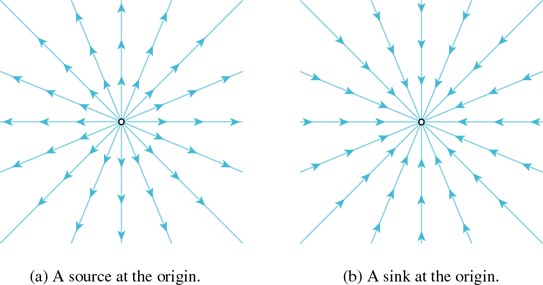
According to Equation (2), the voids with no supercluster sheet between should be attracted to one another. Please note the image again, and note that the voids are usually not exactly spherical, that they might be merging into ever larger voids. This might take some extensive computer modelling to confirm. Logically, though, two small voids should have greater gravitational potential energy than one large void of the merger of the two. The larger void should then have greater kenetic energy. The Hubble law confirms this.
In addition, the attraction of any two voids not separated by a supercluster sheet is not of the classically meaningless "action-at-distance" type. Rather, the outwardly pointing gravitational field of each of two overlapped (merging) spherical voids, should cancel at the overlap. The remaining outwardly pointing fields would continue to expand, ultimately resulting in a single, larger void. Thus attractive gravity might be explained as well as quantified on the largest scale of the universe using the classical -- unaltered -- Newtonian form. Also, the classical form at the scale below the Solar system would be a direct reflection, if you will, of the relation at the larger scale. In this way Newtonian gravity might not only an empirical relation, but also a theory of universal gravitation.


Comments