


...space, Page 9, Large-scale structure and dynamic (gravitation)
- Warren Frisina

- Mar 18, 2019
- 3 min read
Updated: May 21, 2019
6.4.5. Large-scale structure and dynamic
Given two overlapped cosmic spherical voids of mass-energy -m and -n, the following mathematical equivalence is apparent
G(-m)(-n)/d^2 = Gmn/d^2
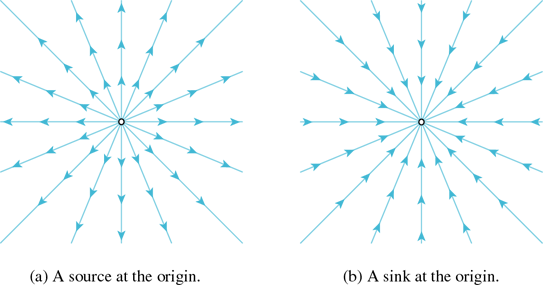
where d is the distance between mass centers such that the voids are mutually "attracted" by this quantity. Physically according to this thesis, the radial, outwardly pointing, gravitational field of each sphere should oppose and cancel in the region of overlap (containing no visible matter) so that the spheres do not repel one another; the remaining volumes continue to expand and meld (due to the observed accelerated Hubble expansion or the proposed repulsive gravitation), such that over sufficient time the composite system approaches a spherical shape larger than the originals, giving the appearance of mutual attraction with identity loss of the two original spheres. This may be confirmed by observation of pairs of overlapped cosmic spherical voids.
The combined spheres would have less gravitational potential energy than the separated spheres, so that the combination should have greater kenetic energy, noted generally by greater outward radial velocities at the shells of the larger voids than of the smaller. This is readily confirmed by observation. These observations may be integrated with streaming observations of Sect. 6.4.1, to help distinguish the proposed radial streaming component from said local effects. In concert with Sect. 2 and with no restriction to void size or to the number of simultaneously overlapped voids, this is also a rationale for (large-scale) walls and for the empirical Hubble Law.
Thus the active physical agents in overlap cases are seen as the mutually gravitationally attractive large-scale voids, which push the (positive) visible matter of the void shells away from the common mass center, preventing gravitational attraction and collapse of visible matter on the large scale, and possibly explaining observed large-scale sheeting and filamentous and often bubble-like structure of the universe -- where these sheets and filaments occur at large-scale void intersections. While the combined mass of visible matter sheets and filaments is generally seen as insufficient by some two orders of magnitude to explain such patterns in the estimated time since the beginning of universal expansion, the proposed void masses should be sufficient, being proportional to the square of the void radii (Eq. (1) or (2)); again, dark mass-energy comprises some 90% of the total mass of the universe.
In classical Newtonian gravity, the assumption is that gravity is universally attractive with the ponderable masses being the active agents, but first, no explanation of the attractive mechanism is offered beyond the physically meaningless "action-at-a-distance," then it was assumed that the source of a particle's gravitational field stemmed from the particle proper, which in turn "contacted" another particle, resulting in mutual attraction; however, the infinities problem with elementary particles arises and the observed accelerated universal expansion cannot be accounted for gravitationally when the particle is assumed to be the gravitational source. In general relativity, it is also assumed gravity is universally attractive, where the curvature of flat space(time) by the proximity of the ponderable positive mass is the active agent; the observed accelerated universal expansion is accounted for by introducing the ad hoc "cosmological constant" of unknown physical nature, rather than as a logical consequence of theory since negative ponderable (i.e. baryonic-like) particles would be required to "curve space negatively," which has no physical basis, while the infinities problem with elementary particles remains. In the proposed, gravity may also be taken to be universally attractive, with the active agents being the large-scale (expanding) cosmic voids (primal negative gravitational field -- sources) that are mutually attracted (merge) when overlapped; this is a complementary view of gravity as universally repulsive and apparently attractive at small scales, as discussed in Sect. 6.3 for example; thus attractive and repulsive effects are implicit.
(continued on Page 10, after Interlude)


Comments