


...space, Page 8, Large-scale gravitational lens (gravitation)
- Warren Frisina

- Mar 15, 2019
- 2 min read
Updated: Feb 12, 2020
6.4.3. Large-scale Gravitational lens
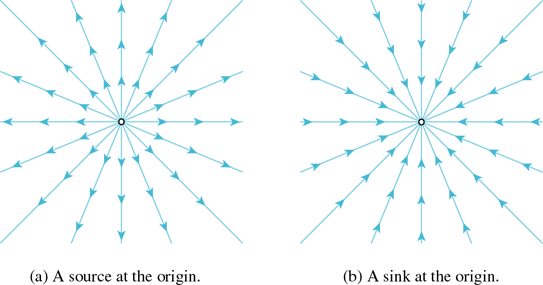
Since most of the mass of the universe is seen to reside in the large-scale voids as gravitational energy (Sect. 3.6.1), the gravitational distortion of electromagnetic and cosmic radiation there through is expected to be marked. Given a spherical void with galactic supercluster shell system, for instance, an off-center light ray is expected to bend away from the center (the void having negative mass-energy or outwardly pointing radial gravitational field) and toward the nearest grouping of visible matter at the shell. This is consistent with classical attractive Newtonian gravity based on visible matter at the shell, but different in origin and predictability, in that it should be virtually independent of the relatively slight visible matter comprising the shell, leaving a straightforward spherical geometry. While not studied by the following authors with regard to the present subject, large-scale gravitational lensing is regularly observed (Schneider et al. 1998; van Waerbeke, Bernardeau & Mellier 1999).
6.4.4. Stability of visible groups
While Eq. (1) may not seem applicable below the scale of galactic superclusters given said derivation (although applicability to the electron in Sect. 4 would contradict this; see also Sect. 6.3), the equation may be appropriate below the galactic supercluster scale generally if in each instance the radius r is extended into the surrounding void such that the relation is satisfied -- amounting about, depending on the value of H chosen, one order of magnitude extension of r beyond the item proper for the Milky Way galaxy, four for gobular star cluster, and one order of magnitude beyond the orbit of Pluto for the Solar system -- possibly indicating suitable dark as well as visible mass-energy for observed motions at each scale.
For instance, at the scale of galactic clusters, it may explain the non-escape of certain high speed galaxies; at the scale of the galaxy, the characteristic stable pinwheel shape of spiral galaxies, which would continually distort without dark mass-energy; and at the scale of the Solar system, the advance of the perihelion of Mercury. Mass for dark as well as visible matter would be positive in these instances -- the dark mass-energy (negative primal gravitational ) field points toward visible matter, i.e. see Sect. 6.4.3. Whether gravity is attractive or repulsive (or mass-energy positive or negative respectively) depends on viewpoint or scale of observation in this thesis; "dark mass-energy" thus comprises both "dark matter" (about visible matter) and "dark energy" (described conventionally as the cosmological constant or energy of the quantum vacuum) at larger scales. See also Sect. 6.3.6 for a discussion of "positive" and "negative" when characterizing mass.
(to be continued above)


Comments