


Resolving the double-slit experiment mystery with particles as gravitational sinks?
- Warren Frisina

- Nov 28, 2020
- 2 min read
Updated: Dec 11, 2020

'Double-slit diffraction is a corner stone of quantum mechanics. It illustrates key features of quantum mechanics: interference and the particle-wave duality of matter. Richard Feynman called the double slit experiment “a phenomenon which is impossible … to explain in any classical way, and which has in it the heart of quantum mechanics. In reality, it contains the only mystery [of quantum mechanics],” ' -- https://www.interaliamag.org/blog/the-double-slit-experiment-explained/
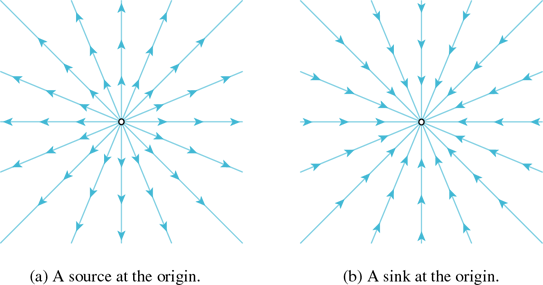
Particle or wave? When even a single electron (or other particle) is projected in this experiment, the particle apparently passes through both slits simultaneously, because it seems to interfere with itself. However, when one slit is covered, or a detector placed, there is no interference pattern. So, what IS an electron? Particle or wave? This is the classic question. But another alternative is overlooked. This other alternative is: neither. The electron may not be a particle nor a wave. It might be an "absence" instead of a "presence" -- an absence of field in a background (plenum) of field, an intersection from all directions and cancellation of the plenum effectively at a point, given sufficient localized energy, i.e. experiment in pair production. This hypothesis is testable in that the gravitational fields of newly created particles should move out at finite velocity if they are local sources. Whereas, the fields of particles as gravitational sinks should immediately connect to large-scale space without violating the light speed restriction of special relativity. Mechanism of gravitational "attraction." When two particles acting as gravitational sinks are in sufficiently close proximity, incoming field lines to both partly block one another's symmetrical field pattern between the particles (in that field lines to each approach from all directions) so that the remaining field lines are more judiciously placed to result in an apparent attractive effect between the particles. This is equivalent to a relative lack of expanding space between the particles; when there is sufficient expanding space between particles, the effect appears repulsive, as observed in the Hubble expansion. (This is an outcome of the proposal that gravity is fundamentally repulsive on the large scale and apparently attractive on the small scale.)* The particle infinities problem might also be resolved if particles are gravitational sinks. Regardless of how close particles might approach, or how close one approaches a particle, the field would not approach infinity, as is the case in current thought. Renormalization would not be required in small-scale calculations, in that the gravitational source could be external to the particle (point) -- everywhere except at the "particle proper." Also, the question of the mass of the quantum vacuum might be resolved, a miscalculation of some 120 orders of magnitude.
The subject is discussed further, with regard to the de Broglie-Bohm interpretation of quantum mechanics, in an article to follow.
* Particles from Gravity, Presented at the 5th International Conference on Quantum and Particle Physics, Sep. 14-25, 2020, Vienna, Austria (webinar); accepted for publication in Archives of Physics Research


Comments