


...space, Page 4, Gravitational sources and sinks -- they are not the same (gravitation)
- Warren Frisina

- Mar 6, 2019
- 3 min read
Updated: Sep 8, 2020
6.3.1. The identity rather than equivalence of gravitational and inertial mass
This view of apparently attractive gravity locally (Eq. (7)) as due to inertia or repulsive gravitation cosmically (Eq. (6)), may also provide a clue to the difficulty of integrating current views of gravity into quantum theory -- attractive Newtonian gravitation is seen as illusory or as an emergent effect, rather than as an explicit quantitative physical effect. Relation (7) is only a mathematical equivalence under restrictive conditions (i.e. of sufficiently close proximity) and does not indicate an identity also because on the left by convention one of the electrons is said to be affected by the gravitational field originating at the other electron, and on the right, one of the electrons is affected by the accelerated Hubble expansion.
In contrast, Eq. (6) is seen as an identity rather than a (conditional) equivalence -- that is, the only physical phenomenon affecting this electron on the left and right is the primal negative gravitational field (the accelerated Hubble expansion). This could explain the equivalence of inertial and gravitational mass for ordinary matter to the limit of experimental accuracy -- there is seen to be an identity rather than any coincidental equivalence. Thus any future experimental discrepancy between inertial and gravitational mass would weaken the thesis, providing another experimental test along with those of the following section.
Unlike conventional Newtonian gravity, note that even when two electrons are considered point particles, as experiment would suggest, the present thesis does not erroneously indicate an infinite gravitational force on mutually approaching infinitesimally close, in that the source of the effect is external to the particle proper, as discussed; the theory does not break down at the smallest scales. The following repititions are seen to be in order because of the fundamental nature of conclusions to be drawn. In the above case of two electrons, Eq. (6) rather than Eq. (7) is seen as physically operative. The electrons are not seen to directly affect one another gravitationally in Eq. (7); gravitational mass employed to directly relate one particle to another is not considered physically valid. The conventional Newtonian expression with two positive particles is seen as a mathematical description of a secondary or emergent phenomenon under restricted conditions rather than as a universal physical law (i.e. that may be applied regardless of proximity); this form is not universal because the particles do not physically affect one another directly. With no mutual gravitational effect for particles, particles are not seen as sources of gravitational fields; rather all normal particles are seen as being affected gravitationally only by said primal negative gravitational field (Eq. (6) -- affected by sources such as cosmic spherical voids comprised of outwardly directed radial fields (having negative mass-energy)). Therefore, particles are seen as gravitational sinks rather that sources. Fields originating at the sources end on the sinks (see also Sect. 6.3.2, 6.4.3).
6.3.2. Gravitational sources and sinks
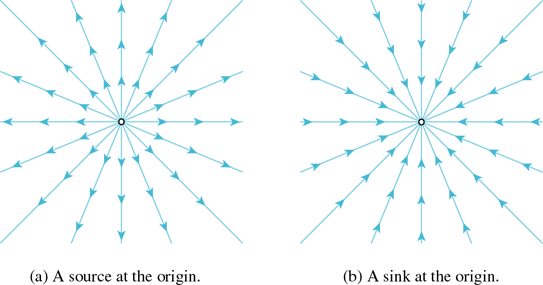
As introduced above, normal matter particles are seen as sinks (having inward pointing radial field lines) rather than as sources of gravitational fields, and by convention are identified as positive mass. The corresponding gravitational sources would be the large-scale spherical cosmic voids having outwardly pointing radial gravitational fields -- negative masses. Field lines originating at the negative mass centers end on positive mass centers, resulting in a repulsive effect -- the composite effect is the observed accelerated expansion of the universe, and apparently attractive gravity below the galactic supercluster scale (intersections of accelerated expanding cosmic spherical voids).
Should there be a great concentration of particles, there would be a corresponding concentration of field lines originating at said sources and ending on the sinks -- elementary particles are viewed as individually related to the sources (Sect. 6.3). Notably, in the conventional interpretation of Newtonian gravity, an isolated particle acting as a gravitational source and an isolated proposed particle acting as a gravitational sink may be represented with similar schematic diagrams -- consisting of a point, at which field arrows approach from all directions (another particle intersecting a field line would tend to move in the direction of the arrow). In the generalized interpretation of Newtonian gravity, particles exhibiting gravitational fields cannot exist apart from large-scale space, in that such space is the source of the particles' field, as discussed. This is similar to the notion that space cannot exist without the particle, where either view indicates that matter and space are closely related (Einstein 1961, p. 153-156.
(to be continued above; introductory material is at home page)

Comments