


Generalizing Newtonian gravity with accelerated expanding space -- D R A F T
- Warren Frisina

- Feb 20, 2019
- 5 min read
Updated: Feb 14, 2021
Copyright (c) Warren Frisina 2019
Abstract
Observations that the expansion of the universe is accelerating rather than decelerating imply that space has negative mass-energy, leading to elementary particles as gravitational sinks rather than sources which assists with the infinities and other small-scale questions, and lending to non-baryonic dark mass-energy as primal gravitational energy viewed at different scales, and assisting with other large-scale questions. Also, electron mass is derived in terms of natural constants.
Keywords: cosmology: theory --- dark matter --- dark energy --- elementary particles --- gravitation --- gravitational lens --- large-scale structure of the universe.
1. Introduction
Despite the advent of general relativity, Newton's law of gravity remains unmatched for practical utility in many aspects of large-scale studies because of its mathematical simplicity. Yet there should be unease in applying it in the conventional manner too far from the Solar system of its empirical development, especially given the unknown simultaneous quantitative relationship among gravity (Newton's or Einstein's), the Hubble law, dark mass/energy and the cosmological constant.
Recall that Einstein introduced the cosmological constant not as a logical consequence of general relativity but because of the seeming need of a symbol to reserve an anticipated blank space in his theory to somehow later explain the observation that the universe is not collapsing in on itself or apparently static as believed at the time, after assuming, like Newton, that gravity was always and everywhere attractive. Subsequently, the cosmological constant was shown to be unnecessary for this purpose, but has been periodically recalled for other purposes, as follows.
The Hubble law is not as straightforward as previously thought. Consider two galaxies far enough apart to be receding from one another according to the Hubble law, where the relative speed of recession was ostensibly directly proportional to the separation distance. By convention a spent primal event was said to cause the recession, the approximate constant velocity of which is continually reduced by a universally attractive gravity. However, these assumptions are not compatible with high red shift observations where cosmic expansion is accelerating rather than decelerating as referenced; the cosmological constant is surmised to account for this acceleration in these references, perhaps by default; again though, this parameter is a former place holder for an erroneous purpose and not a physical explanation of the observed accelerated universal expansion, although it may serve as a label for the inferred negative energy of large-scale space as relates to general relativity (over and above the expansion of the universe implicit in general relativity proper). Also, another version of inflation is called upon to help fit observations (Bucher, Goldhaber & Turok 1995).
The physical nature of dark matter, assumed generally to have positive mass-energy and present about visible matter, is also by and large unknown, its existence inferred by applying Newton's law of gravity to groups of astronomical bodies at various scales. Some 90% of the total mass of the universe is thought to be an unknown non-baryonic mass-energy, distributed as 30% dark matter and 60% dark energy (also known as the cosmological constant or energy of the quantum vacuum, a repulsive effect conventionally believed to act on a larger scale than dark matter. Dark matter is also studied theoretically as an explicit field (Guzman & Matos 2000).
The present study intends to show that these disparate elements -- gravity, the Hubble law, the cosmological constant and non-baryonic dark matter -- are aspects of a single phenomenon, stemming from a Newtonian gravity exercising the negative energy option (but not for ordinary baryonic matter); a relationship with elementary particles is seen as well. "Dark mass-energy will be shown to comprise "dark matter" about visible matter and "dark energy or the cosmological constant" on the larger scale, and shown to be the same item viewed at different scales -- having an explicit gravitational nature.
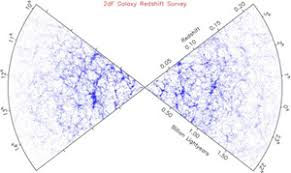
To illustrate, the large-scale structure of the universe with thin sheets and filaments of galactic superclusters surrounding large-scale voids (Geller & Huchra 1989), described by these authors as similar in three dimensional appearance to soapsuds, with the spherical voids representing the predominant large-scale structural elements and the film void surfaces representing sheets of galactic superclusters, can be simulated dynamically by an open-celled sponge under formation by a catalyzed substance that continually expands with accelerated motion; particles that are near to one another appear to be mutually attracted, gathering at the intersections of void walls, while across these large-scale voids particles appear to be mutually repelled. Accelerated expansion may then account for attractive as well as repulsive effects, raising the notion of attractive and repulsive gravity as two aspects of the same phenomenon, and indicating that the underlying physical mechanism of apparently attractive gravity at the smaller scales may be the observed accelerated expansion of the universe, in that acceleration and gravity effects are commonly taken as equivalent. In this case they are identical, suggesting the origin, common origin, of inertia and gravity.
2. Complementing Newtonian gravity
Consider an item of mass n having non-relativistic motion with respect to another of mass m, where /m/>>/n/. If mass centers are sufficiently far apart initially, they accelerate away from one another in said space expansion model. Also, since general relativity reduces to Newtonian gravitation under said conditions, and given the equivalence of gravitational and acceleration effects
G(-m)n / d^2 = nA
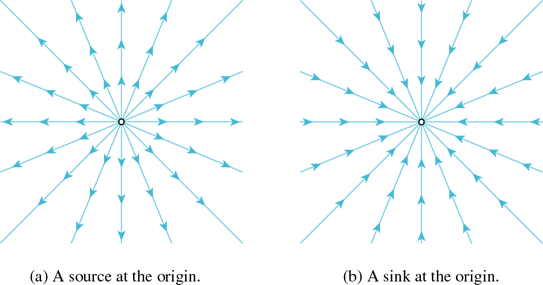
where A is the acceleration of n with respect to m due to this hypothesized Newtonian form of large-scale gravitational repulsion; if m is positive, rather than negative as shown, the items would accelerate toward one another, indicating insufficient separation (the common Newtonian form); in the large scale case where both items have positive mass, yet they are observed to be mutually repulsed with increasing velocity, a non-zero cosmological constant is often introduced to general relativity, implying an unknown substance, field or process; yet, gravity per se (Einsteins's or Newton's) is still commonly assumed universally attractive; also, visible or ponderable or baryonic matter with negative mass is not proposed for this application.
If r is the radius of mass m, and p the radius of n, where r>>p, distance d between mass centers may be replaced by r, thus
A = G(-m(x)) / r(x)^2
where (x) reads sub x. Calibrating A: assuming accelerated expansion at the scale of galactic superclusters, let m = 10^15 Solar masses (1.99*10^45 kg), the local supercluster; this mass encompasses some 100 million light years (LY), so that let r = 50*10^6 LY (4.73*10^20 km); thus
|A| = 5.94*10^-13 m/s^2.
Now to compare this value with an estimate of the Hubble parameter, H = 45 km/s per 10^6 LY, in the same units as A (in view of referenced acceleration observations, H cannot represent a constant velocity per distance); assuming constant acceleration for this estimate (see Section 5 for the general case),
H = (v^2 - u^2) / 2d
= ((45 km/s)^2 - 0 ^2) / (2*10^6 LY * 9.46*10^12 km/LY)
= 1.07*10^-13 m/s^2
which is the order of A.* This estimate of H assumes distance d approached 0 at a primal expansion event, and that a highly variable H quickly approached a constant (see previous paper ("An approach to particles from relativistic kenetic energy", where a complementary derivation was done in the complex domain with results dependent on a rough estimate of universal expansion velocity).
______
* This is a complementary derivation of H as an acceleration, to that of the previous paper; the previous derivation was done in the complex domain, which was not as accurate because of the rough value of v=2c.
(to find page 2 of this article click on "All posts" or "See all" and scroll down)

Comments