


...space, Page 5, Particle non-locality (gravitation)
- Warren Frisina

- Mar 12, 2019
- 2 min read
Updated: Nov 20, 2020
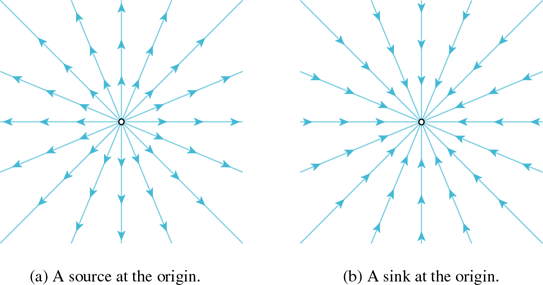
When two particles acting as gravitational sinks are in sufficiently close proximity, incoming field lines to both partly block one another's symmetrical field pattern between the particles (in that field lines to each approach from all directions) so that the remaining field lines are more judiciously placed to result in an apparent attractive effect between the particles. This is equivalent to a relative lack of expanding space between the particles; when there is sufficient expanding space between particles, the effect appears repulsive, as observed.
6.3.3. Particles as sinks instead of sources
When a particle is treated as a gravitational sink rather than a source, it's field can be said to physically exist in large part before the particle is identified as such -- before the particle is "created" in an induced pair creation for instance. Added to the potentiality is the point of intersection and cancellation of the ever-present field lines originating in large-scale space; the arrow heads are added to the ever-present lines origination at said sources. The gravitational effect of a newly created particle then immediately extends to large-scale space without violating the light speed restriction of special relativity, in possible accord with Bell's Theorem and EPR type experiments demonstrating particle non-locality. The notion of potentiality is also prominent in quantum theory. Also, such a sink is consistent with the two-slit experiment, where it is observed that a particle ostensibly moves through both simultaneously in order to produce interference patterns.
6.3.4. The inability to distinguish among particles of a kind
If all particles of a kind did not consist of such fields originating non-locally (Sect. 6.3.3), that is, if particles were sources of their associated gravitational fields as convention would dictate, rather than sinks as presently viewed, then one particle may be distinguished from another, i.e. a newly created from a primitive, in that the new particle's gravitational field would be expanding at a finite speed from the ostensible newly created source, while the field of the primitive particle would extend indefinitely and not exhibit a finite velocity. Such distinguishing among particles of a kind is not in accord with conventional assumptions; therefore, there is a contradiction in conventional practice that, for instance, leads to the infinities problem for elementary particles and the need for ad hoc "renormalization." This indicates another experimental test of the thesis -- if newly created particles do not exhibit gravitational fields moving at finite velocity, they cannot be gravitational sources; in that particles are affected by gravitational fields, they may be treated as gravitational sinks by default.


Comments