


Could particles be gravitational sinks rather than sources?
- Warren Frisina

- Jun 16, 2020
- 3 min read
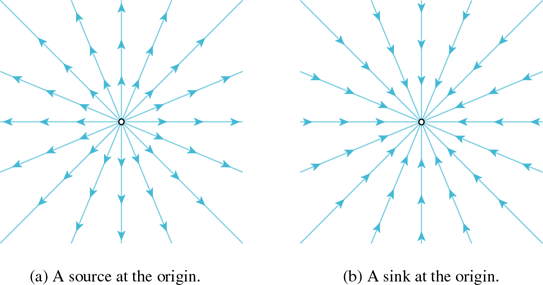
If particles are gravitational sinks rather than sources, questions at the quantum scale, such as the infinities problem, might be resolved. Although gravity was among the first of natural forces to be readily apparent, it remains the most obscure. Classical Newtonian gravity is no help here -- essentially "compact bookkeeping," with no real understanding, no theoretical background. Until Mach, then Einstein and the General Theory of Relativity, where gravity was described in terms of geometry, there was no satisfying understanding. Space here is not just the absence of something but an accomplice to matter. Space is said to react to matter, and matter to space. Rotating reference frames troubled Newton and other physicists until Mach imagined the universe rotating around a stationary frame, rather than visa versa. He imagined "centrifugal force" as originating from the distant matter of the universe. Einstein perfected this notion into general relativity where all reference frames are equivalent -- whether one moves relative to another at constant or variable velocity. "Thus the symmetry among different frames requires the existence of gravitation."* However, this statement might better read "... requires the existence of inertia" given said rotating frame. Might gravity be an emergent effect of inertia? As the universe at large was considered somewhat in the development of general relativity, so might the Newtonian line of thought -- that is, taking the mass of segments of the large-scale-structure of-the-universe into account within the conventional formalism. The key (possibly fatal) word in the classical formalism is "any", where it is classically assumed that any two particles are attracted to one another, which is certainly not the case. Clusters of galaxies are seen to move away from one another (possibly a gravitational effect aside from the cosmological constant and energy of the quantum vacuum, see below). Clusters of galaxies may contain from a few galaxies that remain gravitationally stable, to thousands. Galaxies within such clusters are not observed to move away from another in the sense of participating in universal expansion. In terms of general relativity, the cosmological constant is seen to account for accelerated universal expansion. In terms of quantum theory, the energy of the quantum vacuum is the agent. In terms of Newtonian gravity, gravitation itself might be fundamentally a negative (repulsive), rather than positive (attractive) agent. If particles are repelled on the largest scale, then either Newtonian gravity might be essentially repulsive, or an emergent effect of inertia (of accelerating clusters of galaxies). The origin of inertia and gravity might not be within the particles of material below the level of said clusters, rather in the great cosmic voids above the level of galactic clusters that exhibit the most expansion. This could suggest that particles might be gravitational sinks rather than sources. This hypothesis is theoretically testable, in that the field of newly created particles, i.e. in a particle accelerator, should move out from the supposed sources at finite speed, while the gravitational field of the sinks would not. The field of the sink already exists in proximity to the "particle to be", originating in large-scale space since the Big Bang, and would immediately be connected to large-scale space on creation in the machine. The question of the particle infinities problem might also be resolved if particles are gravitational sinks. Regardless of how close particles might approach, or how close one approaches a particle, the field would not approach infinity, as is the case in current thought. Renormalization might not be required in small-scale calculations, in that the gravitational source could be external to the particle -- everywhere except at the "particle proper." The particle proper might be roughly described as the field lines from space at large, intersecting at a point, and cancelling, such that the point is effectively an absence rather than a presence. Particles might be inherently non-local, in possible accord with Bell's Theorem. The two-slit experiment, where a single particle is seen to interfere with itself, might also be less of a puzzle -- the particle might be everywhere except at where it is apparent on the detection medium; the observer might be noting where the particle is not. The embarrassing calculation of infinite mass of the quantum vacuum might also be resolved, if particles are sinks rather than sources. ______ *Steven Weinberg, Dreams of a final theory, Vintage Books, 1992


Comments